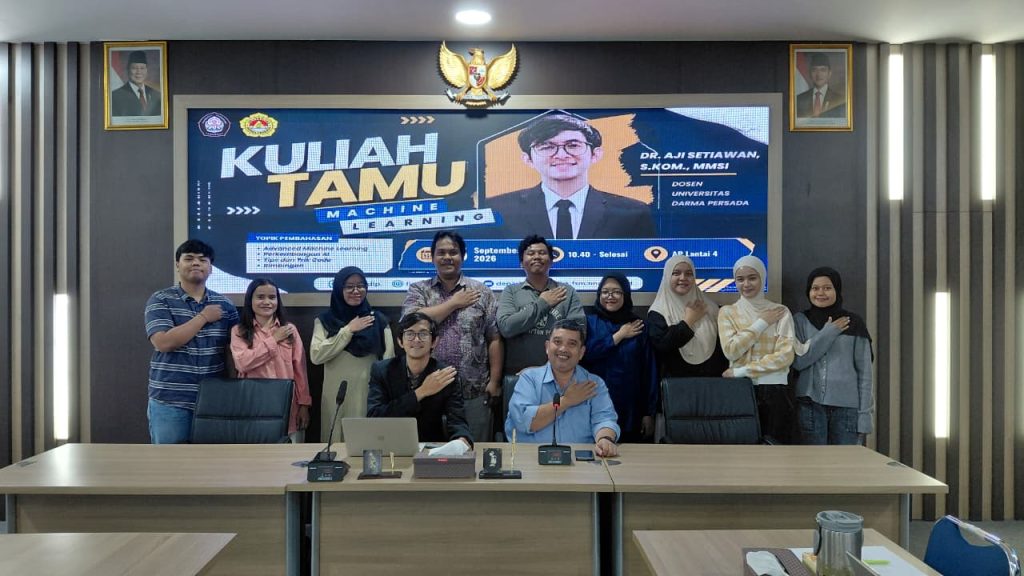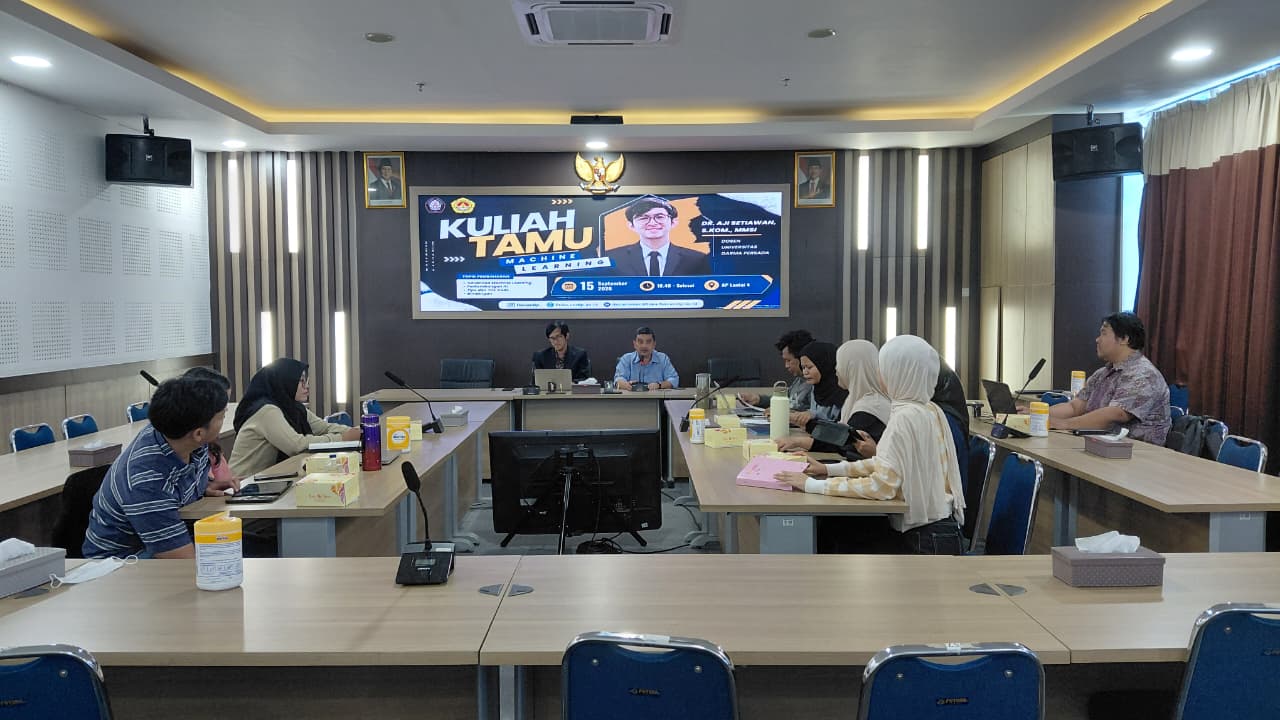
SEMARANG — Master’s students in the physics department at Universitas Diponegoro attended a guest lecture on machine learning Tuesday, the latest session in an ongoing partnership between the department and Universitas Darma Persada.
Dr. Aji Setiawan, S.Kom., MMSI, a lecturer at Universitas Darma Persada, led the lecture starting at 10:40 a.m. in a fourth-floor room on campus. The session ran without a fixed end time and covered four areas: advanced machine learning, recent developments in AI, coding tips and tricks, and one-on-one mentoring.
Setiawan opened by defining machine learning as a branch of AI in which a program learns patterns directly from data instead of following rules a programmer writes out in advance. He described three common tasks the approach handles: sorting data into categories, predicting a numeric value, and grouping similar data points together — the same underlying idea behind tools students already use, such as spam filters and recommendation systems.
He used support vector machines, or SVM, as a worked example of a classification algorithm. An SVM looks for the boundary that separates two groups of data points, then positions that boundary to leave the widest possible gap on both sides. The data points closest to the boundary — the ones that define where it sits — are called support vectors. Setiawan noted that when data can’t be split with a straight line, a technique called the kernel trick lets the algorithm project the data into a higher dimension where a clean separation becomes possible. As an application close to the audience’s own field, he pointed to sorting particle-collision events into signal or background noise based on measured energy and momentum, a classification problem physicists run into directly in experimental data.
The AI-developments segment moved past SVM into neural networks and deep learning, along with how generative AI tools have started showing up in physics research workflows — drafting analysis scripts, summarizing papers, cleaning up datasets before they’re modeled.
The coding segment stayed practical: working with Python libraries such as NumPy and scikit-learn, structuring a Jupyter notebook so results are reproducible, and using Git to track changes to research code. The mentoring segment let students bring their own scripts and thesis-related questions for direct troubleshooting.
Machine learning has become a standard tool in physics research, from sorting through large experimental datasets to image recognition in astrophysics and speeding up simulations. The physics department shares upcoming sessions on Instagram, @fiskundip, and its website, fisika.undip.ac.id.