
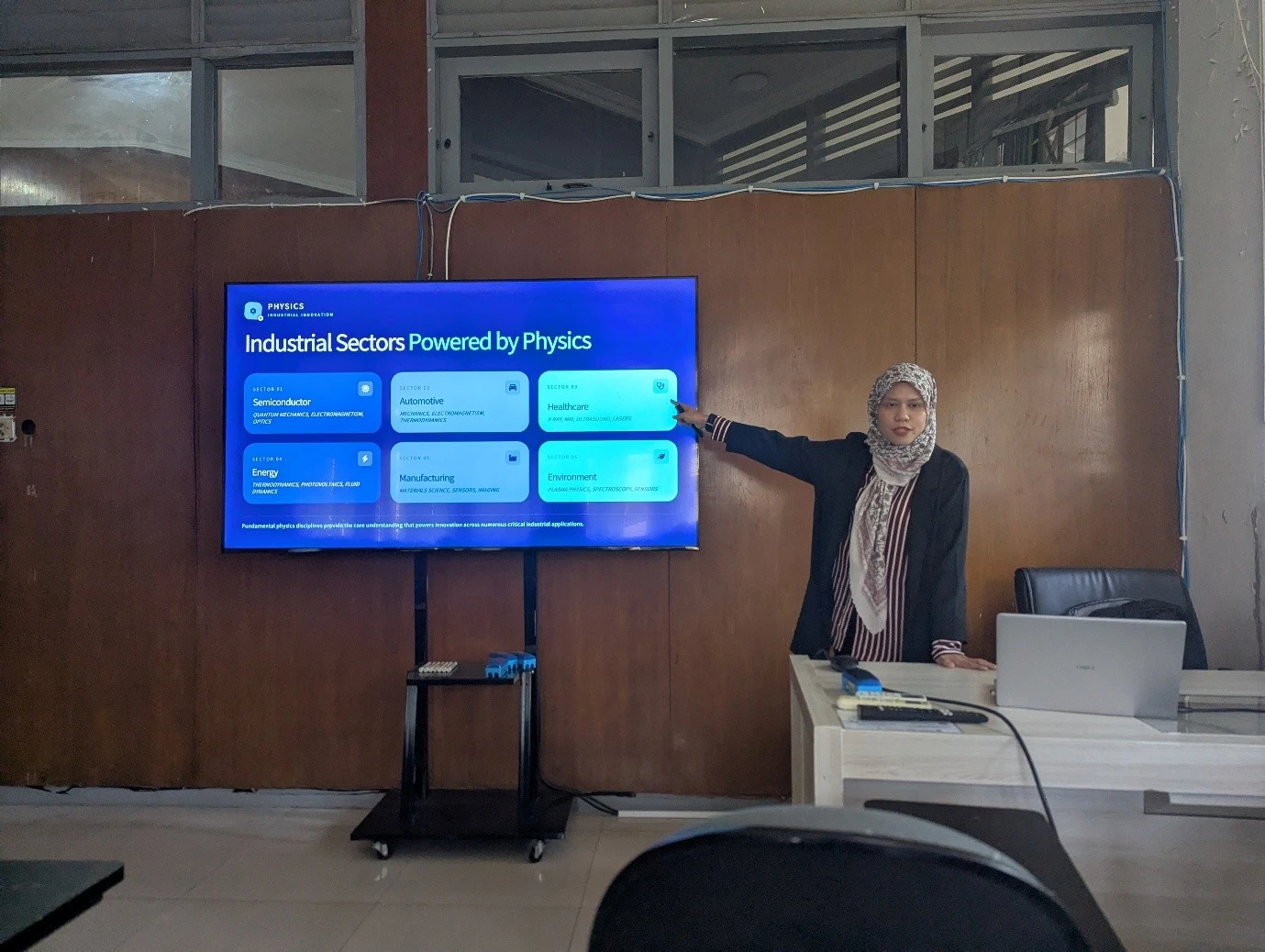
Industrial physics is the application of physics principles to meet technology, measurement, and process needs in industry. Dr Siti Aisyah Abdul Wahab of Universiti Teknologi Malaysia and Conquest Analytical presented the topic in an international lecture of Undip Global Classroom on September 4, 2026.
International Lecture on Industrial Physics at Undip
Dr Siti Aisyah is a postdoctoral researcher at Universiti Teknologi Malaysia and an application specialist at Conquest Analytical. She delivered a talk titled “Physics Across Industries: From Fundamental Physics to Real-World Industrial Applications”. As a result, students gained a picture of how this basic science supports modern industry, from scientific theory and technology to practice in the workplace.
According to the speaker, physical principles do more than explain matter, energy, and natural phenomena. They also support technology, instrumentation, measurement systems, and processes in industry. Physics lets people turn natural phenomena into measurable data, and that data then supports analysis, process control, and decision making.
Industrial Physics Across Semiconductors, Healthcare, and Energy
The material covered semiconductors, automotive, healthcare, energy, manufacturing, and the environment. For example, electromagnetism and optics play a role in semiconductor devices. Healthcare relies on X-ray technology, magnetic resonance, ultrasonography, and lasers. In the energy sector, thermodynamics, photovoltaics, and fluid dynamics support the development of the technology.
The speaker also outlined the path from basic concepts to decisions in industry. First, people understand the physical principles. Next, they measure the phenomenon, use instruments, and process the data. Finally, they decide on action based on the analysis. Therefore, successful technology depends on accurate measurement and data interpretation, not only on mastering theory.
XRF and Optics as Technology Examples
X-ray fluorescence (XRF) served as a concrete example. This technique uses the interaction of X-rays with a material to identify its elemental composition. Measurement involves three steps: X-rays excite the sample, a detector picks up the characteristic fluorescence signal, and software analyzes the data. As a result, industry uses XRF for material analysis and quality control.
In optics and photonics, spectroscopy provides chemical and structural information about materials. Meanwhile, lasers serve material processing, measurement, and precision control. Optical sensors also turn changes in physical characteristics into signals for monitoring and automation in industry.
Data and Career Opportunities for Graduates
The lecture also highlighted data-driven physics, a growing part of industrial physics. Modern industry must collect, process, and analyze data from many sensors before the data becomes meaningful. Therefore, skills in programming, data analysis, interpreting measurements, and systems integration matter more and more for graduates.
Career paths vary widely. They range from technology research and development, data analysis, and instrumentation to product specialist and technical support roles. Moreover, industry looks for graduates who can review technical specifications, solve problems, read data, communicate, and adapt to new technology. The speaker’s experience in postdoctoral research and industry shows why people must bridge theory and field needs.
This lecture is part of Undip Global Classroom’s effort to broaden students’ global outlook through international academic and professional speakers. Diponegoro University hopes the program will remain a place to exchange knowledge. In this way, it can strengthen ties between universities, research, and industry.
Source: Diponegoro University organized the event. The Undip Global Classroom guide explains the program, and readers can find the speaker’s home campus at Universiti Teknologi Malaysia.